When clients come to me for AI and automation solutions, they often expect me to throw a brand-new tool at them — a complex platform, a shiny app, or the latest tech trend.
But that’s never where I start.
As an AI & Automations Solutions Architect, my methodology is simple:
Minimize disruption. Maximize what you already have.
Because real business optimization isn’t about adding more. It’s about making the right things work better.
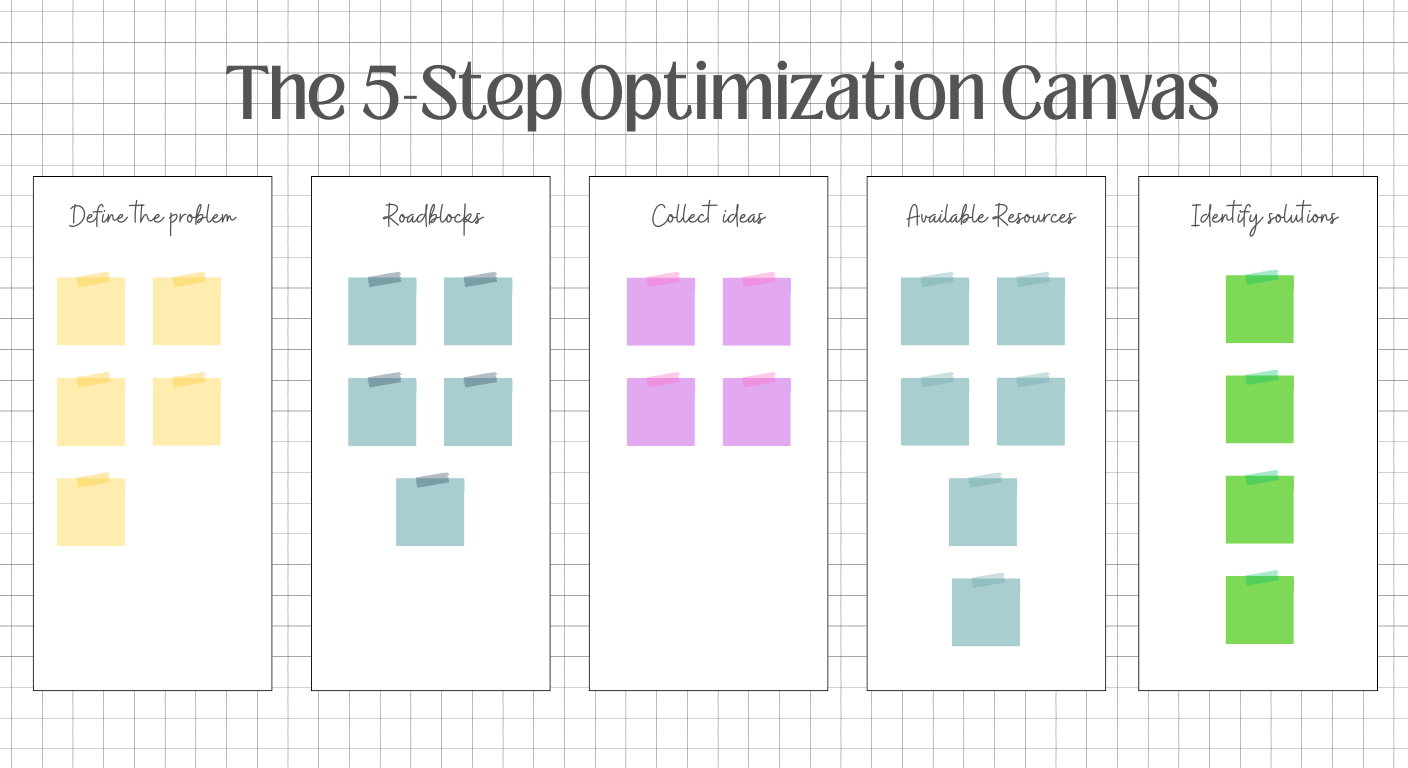
To do this, I use a framework I designed specifically for business owners, teams, and organizations who want clarity before complexity:
The 5-Step Optimization Canvas
This is the exact process I use in every brainstorming session – whether I’m optimizing a startup’s backend workflows or building Zapier/Make workflows for a growing business.
1. Define the Problem
We start by identifying the real goal.
Not the surface-level issue. Not the symptom. But the outcome they want.
Then we break down the challenges directly tied to that goal.
Think of this as zooming out before zooming in.
Examples:
→ Getting mixed inquiries because everything goes to one inbox
→ No standard process for responding to clients
→ Organization issues with email or messenger channels
→ No system or business analytics to understand the data needed to make the right decisions.
This step ensures we’re solving the right problem.
2. Spot the Roadblocks
Once the goal is clear, we uncover everything standing in the way.
This is where clients usually have their first “ohhh…” moment.
Roadblocks often include:
→ Manual tasks slowing down response time
→ Multiple communication channels being used randomly
→ Tools not integrated or used to their potential
→ No centralized system for updates or tracking
Mapping this out gives us transparency.
We can’t fix what we can’t see.
3. Collect Ideas — Without Bias
This is my favorite part.
Here, we gather all ideas:
→ Realistic ones
→ Unrealistic ones
→ Techy ones
→ Simple ones
→ Messy ones
The goal is possibility, not perfection.
This is where clients get creative — and where the best ideas usually show up.
4. Audit Current Resources
Before we think of introducing anything new… we look at what they already have.
This step embodies my core principle:
Minimize disruption. Maximize existing assets.
We review:
→ Tools already being used (Google Workspace, Facebook Page, Gmail, Google Sheets, etc.)
→ Processes that exist (even if messy)
→ Data they’re already collecting
→ People involved in the workflow
Most businesses already have 60% of what they need — they just aren’t using it effectively.
5. Identify Solutions
Only after the first four steps do we design the actual solution.
And this is where the transformation happens.
Depending on what the client has, we either:
→ Create a streamlined workflow using their existing tools
→ Connect apps they didn’t know could talk to each other
→ Introduce a new tool only if needed
→ Optimize their system to reduce friction, errors, and manual work
Sometimes the solution is a ManyChat routing flow. Sometimes it’s a Zapier automation. Or even a GoogleSheets App Script.
It can start by simply organizing systems they already use.
The goal is always the same:
Build a smarter system — not a more complicated one.
🔍 Why This Framework Works
Because unlike most consultants who start with: “Here’s the tool you need,”
I start with: “Here’s what we can optimize with what you already have.”
This approach:
✅ Saves money
✅ Reduces learning curves
✅ Avoids disrupting the team’s workflow
✅ Creates systems people are actually willing to use
✅ Builds foundations that are scalable, not chaotic
And most importantly — it gives clients clarity.

This is an actual miro.com board that I used to brainstorm with a client. I love using Miro – it’s perfect for collaborative discussions and brainstorming, it’s literally a GIANT online whiteboard.
💡 Want Me to Build One for You?
If you’re planning to automate your business, streamline your workflows, or integrate AI… but you don’t know where to start — this is where I come in.
I’ll guide you through the 5-Step Optimization Canvas and help you:
🔵 Uncover hidden inefficiencies
🔵 Map the gaps in your processes
🔵 Build an automation roadmap based on what you already have
🔵Recommend tools only when absolutely necessary